Cool Things – 11.03.18
Some cool things that have crossed my path recently:
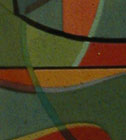
I saw this piece by artist and designer Dorothy Hafner at the Brooklyn Museum. (I apologize for the poor quality of the photo!) Take a look at the good photos of her work that appear on her website, and here and here.
:: :: :: :: ::
A terrific film is airing on PBS World this week called Who Does She Think She Is? It profiles five women artists who are also mothers and the choices that they had to make to stay in balance in both roles. It is such an inspiring film which drove me to tears at the end. I identified so strongly with these women and I could have listened to them speak all night long. I was especially touched by the stories and work of two of the visual artists in the film: Maye Torres and Mayumi Oda.
I was captivated by the words of drummer Layne Redmond who spoke of the legends of the goddesses who pre-dated Judaism. I had been exploring this on my own, wanting to know how my people lived before monotheism and the dogma of religion arrived. I had read what I could find about Astarte, a goddess of the earth who was revered in the Middle East, and Redmond mentioned her name, saying that she too had been a drummer and that there had been many goddesses depicted in “pre-historic” art as being strong women who carried a drum!
I also fell in love with the paintings of Edith Vonnegut, whose work I’d never seen before. Visit her web site and take a look around. She creates stunning paintings of beautiful women as super heroes within the family and as activists around the world. These aren’t the type of super heroes who wear capes. These women are full figured nudes and angels. Any mother could recognize them!
The film is directed by Pamela Tanner Boll and co-directed by Nancy C. Kennedy.
:: :: :: :: ::
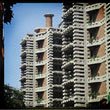
Another film that I highly recommend is Garbage Warrior, which I recently saw on Sundance. The film is about Taos architect Michael Reynolds who builds beautiful houses called Earthships out of natural materials and discarded tires, plastic and glass bottles, and soda cans. The film chronicles his career, along with his fight for the right to experiment with design. It also takes us to the Andaman Islands of India, where in the course of two weeks, Reynolds and his crew build a dwelling (again out of natural materials and garbage) in a town destroyed by the 2004 tsunami. As he’s building it, he is teaching his methods to the other engineers, architects and builders from the town. He’s a very inspiring figure fighting a crucial battle that could well move us along toward a sustainable way of life.

Interior Stair - House by Architect Michael Reynolds - From the film Garbage Warrior by Oliver Hodge

Architect Mike Reynolds works on a Can Wall - New Mexico - From the film Garbage Warrior by Oliver Hodge
:: :: :: :: ::
This photo stopped me in my tracks the first time I saw it. The look on this girl’s face really fired my imagination. I saw it as a mixture of innocence and knowing, and I absolutely loved the shape and the movement of the wisp of her hair which the wind is blowing across her cheek.
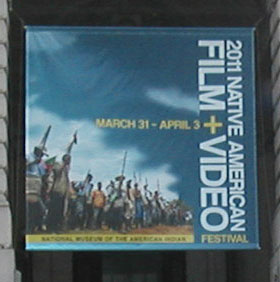
It is part of the exhibition titled GRAB which will be showing at the National Museum of the American Indian, George Gustav Heye Center in New York City through April 17th.
From the NMAI web site:
This exhibition presents photographs by Idris Rheubottom, Tony Craig, and Cybelle Codish, of the little-documented Grab Day. An annual tradition in the villages of the Laguna Pueblo [ . . . ] The photographers worked under the direction of filmmaker Billy Luther (Navajo/Hopi/Laguna Pueblo), whose current documentary Grab follows families preparing for this important tradition. Grab is an official selection of the 2011 Sundance Film Festival.
Tags: Architect Michael Reynolds, Brooklyn Museum, Dorothy Hafner, Edith Vonnegut, Garbage Warrior, GRAB, Layne Redmond, Maye Torres, Mayumi Oda, National Museum of the American Indian, Oliver Hodge, Who Does She Think She Is
March 18, 2011 6 Comments
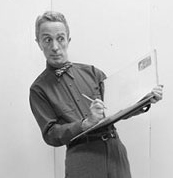
Norman Rockwell Behind The Camera at The Brooklyn Museum
“The balopticon is an evil, inartistic, habit-forming, lazy and vicious machine! It also is a useful, time-saving, practical and helpful one. I use one often—and am thoroughly ashamed of it. I hide it whenever I hear people coming.”
Eventually photography became so integral to his process that he wrote, “I challenge anybody to show me when I started to use photographs. I’ve always been knows as “The Kid With The Camera Eye’.
Norman Rockwell was born in New York City. He dropped out of High School to attend the Art Students League. By the age of 17 he’d become the Art Director of Boys Life Magazine. He was 22 when he did his first illustration for the Saturday Evening Post. The association between the publication and the artist lasted 47 years.
Some of his Saturday Evening Post cover illustrations have become a iconic images of American culture. Most people of a certain age are familiar with them. But it wasn’t until I saw the photos in this exhibit that I could even begin to imagine the amount of careful thought and attention to detail that went in to each illustration.
Not only was Rockwell drawing and painting these images, but more than anything, he was directing the models (mostly family and friends) to pose in the photos from which he’d work. Then he’d cobble the images together into the strong narrative in his paintings.
The exhibit reminded me of how clever and witty the narratives were. The words quoted above are the absolute truth. The photos and over head projector may have helped him become more prolific, but there’s no way that anyone other than a master of drawing and painting could have turned out these works.
The photos show us that when Rockwell wanted to depict his subjects in motion, he’d have someone off camera holding up the edges of the fabrics of their clothing, or holding up the ends of a girl’s long hair to give the effect. He even got down on the ground and helped to pose the dogs who appear in his paintings.


A Day In The Life of A Little Girl – Photo shows 4th image in top row
-
His enthusiasm for his subjects and their stories all but bubbles off the page. Of the photo session for the iconic painting Girl With A Black Eye (below), it was said, “By the time he finally achieved the perfect expression (on the girl’s face) he was on the floor laughing and pounding his fists.”

I got a great laugh from his 1946 painting titled Maternity Waiting Room. Back in those days, men were not invited into the Delivery Room when their children were being born, but instead were relegated to a Waiting Room. In this painting, Rockwell illustrates the way different men cope with the pressure and excitement of this milestone in their lives. We’re shown the Frightened Novice (far left), the Chain Smoker (smoking in the hospital, just as it was done in the old days), and the Tragedian (whose face is buried in the sofa cushion). But my favorites were the Father of Eight, who has fallen asleep on the couch, and the Hearty Salesman, who sees this as a moment to do his pitch and maybe close a deal or two before his baby is born.
The facial expressions that Rockwell was able to achieve are just sublime. They can tell an entire story in a moment’s time.
Of the painting below, originally made for The Saturday Evening Post but never published, it was said to be “a fitting metaphor for the artist’s own struggles with The Post as he weighed the end of their 47 year association.”
With a move to Look Magazine, Rockwell’s work traded away a bit of its cheeriness and humor and turned toward tackling the subjects of the day: Equal Rights, The War In Viet Nam, and Man’s Landing on the Moon. Below is Rockwell’s 1967 painting New Kids In The Neighborhood and the photos from which he worked.
The painting below, titled The Problem We All Live With, seemed much more grittier when I saw it “in person”. Though the images aren’t available, the museum showed photo studies of the fisted hands of the Federal Marshalls, as well as studies of the tomato that had been thrown at the wall.
This exhibit, which runs through April 10th, begins as an inspiring example of one artist’s work. But by the time you’ve walked through it, you’ve also traveled through half a century of American life, its wars, its politics, its new technology, and the drama and beauty of daily scenes and items which have long ago faded into history.
Here are some of the headlines seen on some of the Saturday Evening Post tear sheets:
September 4, 1943 – We Skip Bomb The Japs
November 27, 1943 – A Gay Short Story
August 16, 1947 – LICENSE TO KILL – The Truth About The Shocking Official Negligence Behind The Growing Death Rate On Our Highways
May 23, 1953 – Humphrey – The Man Ike Trusts With The Cash and Case History of a Maniac Who Was TURNED LOOSE TO KILL.
June 11, 1955 – How Communists Blackmail Refugees
May 25, 1957 – How Will America behave if H-BOMBS FALL
I recommend this exhibit very highly. Even if commercial illustration isn’t your thing, it is fascinating in and of itself just to see how the iconic paintings were composed and how they came to life.
There is so much going on at the Brooklyn Museum right now. Later in the week I hope to find time to write about the Lorna Simpson exhibit and the Tipi exhibit. (I also caught a glimpse of the “reOrder” exhibit, currently under construction, which promises to be amazing.)
Norman Rockwell: Behind the Camera
Through April 10, 2011
Robert E. Blum Gallery, 1st Floor
Norman Rockwell Behind The Camera from Norman Rockwell Museum site
Balopticon, a precursor to the overhead projector, used extensively by Rockwell
All photos courtesy of The Brooklyn Museum except for
Girl With A Black Eye – taken from here
Marriage Counselor – taken from the Norman Rockwell Museum
Maternity Waiting Room – taken from here
Tags: A Day In The Life Of A Little Girl, Brooklyn Museum, Girl With A Black Eye, Maternity Waiting Room, New Kids In The Neighborhood, Norman Rockwell Behind The Camera, The Dugout, The Gossips, The Marriage Counselor, The Problem We All Live With, The Soda Jerk
February 21, 2011 No Comments
Fred Tomaselli at The Brooklyn Museum
One of the first pieces in the exhibit, whose name I’ve forgotten, is a panoramic view of constellations. And the stars are labeled. On the left side, each star is labeled for a species that’s become extinct. On the right side, each star is labeled for a rock band whose concerts Fred Tomaselli has attended.
Wow.
This piece really hit home with me. I am close in age to Tomaselli and like most of those of my generation, my teen/early adult life was hedonistic. In younger days, my top priority in life was knowing which band was coming to town next and making sure that I had a ticket to see them. It’s only recently that I’ve begun to reflect on how my own life long indifference to Natural Law along with my pleasure seeking ways have contributed to the damage. I felt that this piece of artwork made for a brilliant juxtaposition of themes.
In Russell Mean’s most recent video update at Republic of Lakotah, he speaks about the fact that when we lose one species, all the rest of life pays the price. But if we were to lose the human beings, the rest of the species would flourish.
I thought of Tomaselli’s constellation as I listened to Means’ words this morning. The constellations really shook me up without being the least bit preachy or cloying or new agey. It was just stars, constellations and text on a black background and it hit really hard.
(It’s not my intention to disparage rock bands or to blame them for what human beings have done to the earth and its inhabitants. The musicians whom I listened to when I was in high school and college brought more truth my way than anyone or anything else I’d experienced up until then. Nor would I ever want to trade the experiences that I had at those concerts in 1970s and 80s. I so loved being part of that circus.
It’s just that lately I’ve been thinking more in terms of the balance and moderation (or lack of balance and moderation) in American life. I was also struck by the fact that Tomaselli’s piece appeared to be balanced — it seemed to have as many stars labeled for extinct species as it did for rock bands.)
It’s funny that this was the piece that stayed with me days after I’d been to the museum, because it was a bit different, especially in scale, than most of the other pieces. I found something to love in every single piece that I saw in this exhibit and I’ll definitely be back to see it again.
For those who are unfamiliar with Fred Tomaselli, you can see some of his work on line and in books, but it does nothing to prepare you for being in the same room with the pieces. For the most part, they are gigantic collages, the assembly and attention to detail of which is painstaking. Tomaselli uses images meticulously trimmed from catalogs, pressed leaves, paint and pills to create his compositions. The pills are used almost like beads, often appearing to be strung together in the same fashion, but sometimes the pills just dot the image here and there, along with painted mandalas. When viewed up close, you can see that the outlines of the central figures in the pieces tend to have tiny painted flames leaping from them. Every square inch of every piece is so deeply laden with detail that there’s no way to take all of it in in one visit.
In the back room of the gallery, there was a series of front pages of The New York Times, in which the artist had painted over the images. One showed (my beloved) Nick Swisher standing at home plate waiting to high five Curtis Granderson on what was probably Opening Day of this season. Tomaselli painted a sort of twisted chain link fence over the image, making it look as if both Granderson and Swisher had their hands wrapped around the chains.
The entire exhibit was just amazing and wonderful. I know that I end every one of my reviews by saying “Don’t miss it”, but there’s no other way to say it. If you’re in New York City and you like Tomaselli’s work, get thee to the Brooklyn Museum as soon as possible.
-
Fred Tomaselli at The Brooklyn Museum
A great video of the artist at work in his studio.
Tags: Brooklyn Museum, Fred Tomaselli
October 25, 2010 No Comments
The Channels Switch But It’s All Television
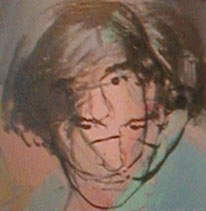
People take pictures of each other in front of Warhol art at the Brooklyn Museum. Seems appropriate. Below are a few scenes from Andy Warhol: The Last Decade.
Disclaimer: It’s a poor artist who blames her tools, but my camera is old and outdated even by digital point and shoot standards. Still, the photos do absolutely NO justice to the originals, all of which were so beautiful. If you’re in Brooklyn, go and see for yourself. The exhibit runs through September 12th.
The piece above was my favorite in the exhibit. It’s called Oxidation Painting [in 12 parts], made in 1978. Believe it or not, the materials are acrylic paint and urine on linen. I love the metallic greens and golds and the textures. These were among the first abstract paintings that Warhol did. From the description of the painting: “By urinating on the canvas he succeeded in creating the ‘physical presence’ to which he aspired in the act of painting, and simultaneously parodied the act of painting.” Statements like these made Warhol so beloved and make him so sorely missed.
The exhibit also includes Warhol’s films, a television series, and a wall full of covers of Interview magazine in addition to many more paintings, including his religious paintings.
Black and White Ads above

Elsewhere in the museum . . .
I’ve had a soft spot for Josef and Anni Albers ever since I saw an exhibit of their work at the Cooper Hewitt ages ago. These pieces are called Homage to the Square; they are from 1957. I worked in an architect’s office in the early 1980s where we would turn out page after page of parodies of this type of work. But I don’t love it any less.
I fell in love with this little vessel by ceramicist Rick Dillingham, whom I’d never heard of before. On the plaque beneath this piece, I read that the artist was a contemporary of mine who’d already passed away, which broke my heart right on the spot.
My only complaint about my visit to the museum was that First Nations artists from the so-called “Americas” were barely represented. It could be that I just didn’t know where to look for them and didn’t have the time to visit the entire museum. But amongst one of the American painting collections I found a room which had a few pieces made by Native artists, like the piece above.
Judy Chicago’s The Dinner Party is one of the most stunning works of art I’ve ever seen. The degree of detail is amazing. This is just one little detail that appeared on one of the runners for one of the place settings.
Stained glass from one of the 4th floor galleries [above].
I closed out the visit by seeing works by two of my all time favorites . . .
Diego
and
Georgia.
Tags: Andy Warhol, Brooklyn Museum, Diego Rivera, Georgia O'Keefe, Josef Albers, Judy Chicago, Oxidation Painting, Rick Dillingham
August 30, 2010 No Comments