Peridance Contemporary Dance Company – Preview Performance
Peridance Contemporary Dance Company
Preview Performance
Saturday, January 21, 2012
Salvatore Capezio Theater
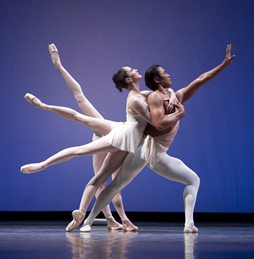
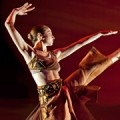
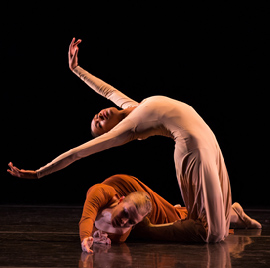
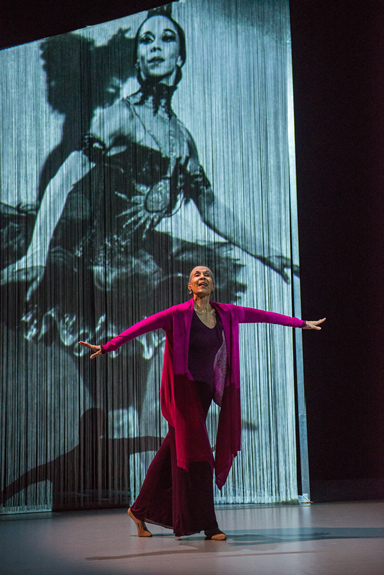
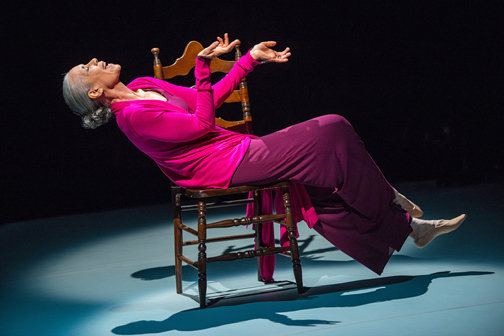
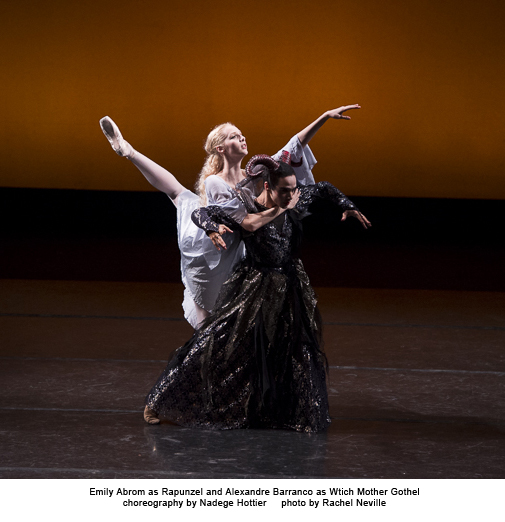
Peridance Contemporary Dance Company has been on hiatus since 2007 as the Peridance Capezio Center went through a transition, moving to new quarters with its own in-house theater. In Fall 2011, the company re-emerged. The concert that I saw at the Capezio Theater was a preview performance, leading up to a formal season this coming May. The company offered a nicely varied program which showcased a group of gorgeous charismatic dancers and imaginative choreographers.
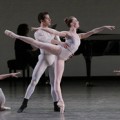
The program opened with an excerpt from Igal Perry’s Constructs for 4, beautifully danced by Shay Bares, Nikki Holck, Zach Thomas and Andrew Trego to the music of J.S. Bach. As with much of Perry’s choreography, classical ballet is at the core, but the movement is very much contemporary. Balanchine’s influence seems present during certain passages of this quartet, but Perry’s elegant formations speak in an updated voice with atmospheres that are more modern. I especially loved the lifts, which seemed so effortless. I was also taken by the way that the movement seems to open up so beautifully at moments when the strings reach the end of a phrase. Perry’s choreography and this group of dancers are extremely musical.
Leading from Behind, choreographed by Greg Dolbashian, received its World Premiere. It’s a modern piece set to electronic industrial music by Loscil. The music is quite menacing and tension is building as the dance opens with one man standing apart from a group of five women. The women line up shoulder to shoulder. The line becomes a motif that reappears throughout the dance, and much of the featured movement stands apart from the line. I especially liked one section in which the movement seems to spin off from or move through the line. One or two dancers will work apart from the line and as the dance goes on, it seems as if a series of battles of the will ensue. The choreography is clever and unpredictable. This piece was performed by Peridance’s Youth Ensemble, a group of strong, confident and well trained students who show great promise.
Kristin Sudeikis’s jazzy I am you was also given its World Premiere. The dancers all wear black pants, but the men are bare chested and the women are wearing nude colored tops. The dancers seem stripped down to explore issues of identity and influence, and the piece even includes Chorus Line type sections in which the dancers face the audience and speak to describe themselves, or perhaps to describe aspects of the human condition. The piece had an uplifting Broadway feel and the audience responded with great enthusiasm.
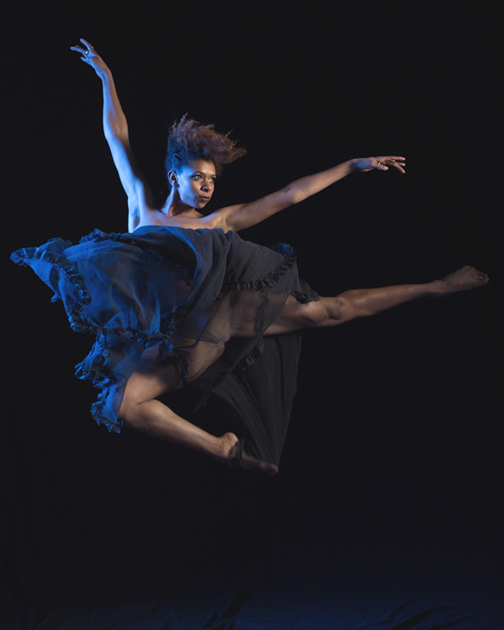
Igal Perry’s El Amor Brujo, set to the gorgeous score by Manuel da Falla, is a moving piece with a flamenco flavor. It is touching, bittersweet and packed with emotion. In the original libretto by Gregorio Martinez, the young gypsy woman Candela has lost her husband Jose, but Jose’s spirit continues to haunt Candela and won’t release her to her lover Carmelo. Perry tells the story with a slight twist – he sees Candela and Jose as being divorced rather than separated by death. Jose isn’t a ghostly spirit, but a physical presence in the story.
Nikki Holck’s Candela made my heart ache as she passes from her lover Carmelo (played by Attila Csiki) to her husband Jose (played by Andrew Trego). With quiet gestures and Perry’s imaginative choreography, she clearly expresses two different kinds of love. Though Candela and Jose are no longer together and have to move on, they embrace as if to respect the love they once had, even though they are now resigned to love each other from a distance.
Jose is a proud and masculine character, but beneath the surface he’s wounded. I was really taken by the way that Trego’s movement revealed Jose’s vulnerability. Joanna DeFelice is the very image of quiet strength as she dances the role of Lucia, the woman with whom Jose falls in love, allowing him to loosen his grip on Candela and let her go. Attila Csiki moves with such elegance and he expresses such tenderness as the romantic hero Carmelo. Some of my favorite passages in the dance are the ones in which the four characters move together at close quarters, with Candela weaving through the formation from one man to the other.
The ensemble delivers a very strong and stirring performance that really touched my heart. What affected me most about this dance was the subtlety with which the story is told. Perry and his dancers trust the audience and allow us to experience the emotion of the story without the use of cliched characterizations. The choreography never travels in the predictable direction. The dance truly does do all the talking and the story unfolds in a beautiful quiet fashion. I also appreciated the details. When the focus turns to the main characters, the company fills out the composition with lovely movement on the sidelines. Subtle lighting is used to strong affect too, in conjunction with projections along the back wall of the stage.
This is a wonderful dance that I’m looking forward to seeing again.
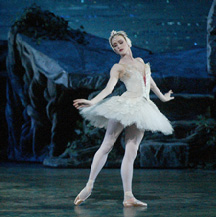
The Peridance Contemporary Dance Company will present its major New York City season this May, featuring works by Igal Perry, Kristin Sudeikis and Sidra Bell. Be sure to see one of their shows at the Salvatore Capezio Theater. Dates are May 5 and 6, 12 and 13, 2012. Visit their web site for further details.
Tags: El Amor Brujo, Greg Dolbashian, Igal Perry, Kristin Sudeikis, Peridance Contemporary Dance Company
January 25, 2012 No Comments
APAP Showcases at Peridance
APAP Showcases at Peridance – Program A
January 8, 2012
The APAP Showcases at Peridance were nothing short of a beautiful dream which introduced me to several companies whom I’m looking forward to following in the future.
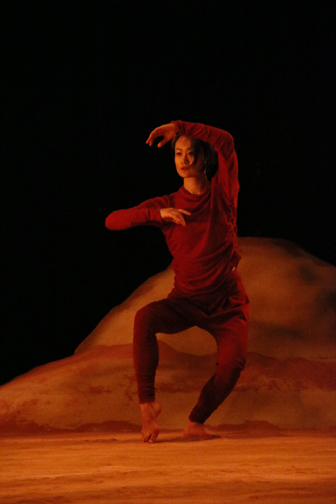
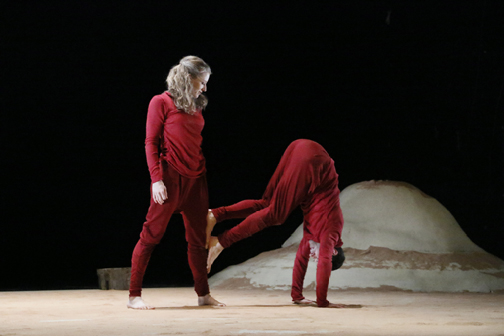
Program A opened with In Dividing, a moody modern piece with earthy sepia tones, presented by the Mettin Movement Collective. Throughout a series of vignettes, one individual stands apart from the rest of the dancers, who seem to comprise a tribe. I was surprised to read that choreographer Sarah Mettin is a 2011 graduate of the Conservatory at Purchase. Her artistic voice and the dancers who make up her company seemed quite mature. I especially liked the beautiful formations and counterpoint of the choreography, and the wonderful assortment of dancers who make up the company. This is one to watch.
Kate Thomas’s Ballet Neo presented The Appalachian Suites Project, a lovely lyrical contemporary pointe piece which opens with four women dressed in black. Their movement is expansive, with long extensions and arms that reach. There was the temptation for me to read things literally and to wonder if these women were mining wives or even widows. Their movement at times is reserved and the lighting is moody, yet their faces are not pained and their spirits seem very sisterly. As the dance progresses, two men join the group for a stirring series of partnering sections. Just beautiful. Ballet Neo also presented a gorgeous pointe piece called Measurement and Caution, danced by RJ Johnston and Bethany Lange. The dance was elegant and full of effusive movement. There was such strong chemistry between the partners.
Things became light hearted as Nathan Trice Rituals presented Chim Chim Cheree, accompanied live by a jazz trio and danced by four couples. In this theatrical piece, the women sang skat as they danced. The dance was a great and organic blend of Broadway and Trice’s signature, often quirky modern style. So entertaining and very appealing.
Jacoby & Pronk presented two solos. Prince Credell danced an Alonzo King piece titled Door, to ancient shofar sounds and Hebrew chants. I loved the primal feel conjured by the raw honesty and muscularity of the movement, the ancient music and the earthy costume. Drew Jacoby delivered an electrifying performance of Emery LeCrone’s contemporary ballet Aria. Jacoby has such an enormous presence on the floor and always manages to seamlessly blend fierce feminine strength with deep emotion and ballerina grace.
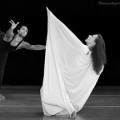
I was especially moved by Tomoko Imanaka’s Okuni performed by Tomoko Dance Art Company, a piece that seems steeped in traditional Japanese forms. The women make their entrance dressed in the black and white outfits and straw hats that we’ve seen in artwork of Japanese rice paddy farmers. Much of the dance travels in a circle. Much of it is performed in unison with a ritualistic feel. A woman in a gorgeous colorful silk kimono joins them. I think that she is Okuni, a temple dancer who founded Kabuki art forms. As the dancers shed their hats and white vests, they remain dressed in black as they perform a magnificent dance with the very colorful and glamourous Okuni at the center, mixing modern forms with traditional Japanese images.
Peridance Contemporary Dance Company performed an excerpt from Igal Perry’s El Amor Brujo, an elegant and dramatic piece which seems to explore the unseen forces that play with romance. At one point, a man and woman sit opposite each other and tentatively rise and move toward one another. They hesitate at first and never quite make it. When the four women and four men of the piece do dance together, they continually change partners. A pas de deux becomes a pas de trois. At one point one partner seems drawn away by a magnet or blown away by the wind. I really liked Perry’s unique take on this theme and I’m looking forward to seeing the full length piece later this month.
Olivier Wevers’ Flower Festival was performed by Seattle based Whim W’Him, a company who is completely new to me and who absolutely knocked me out with an amazing comic performance. Two men in business suits sit at opposite corners of the floor, having removed their black dress shoes. One at a time the men approach each other. They are teasing and challenging as they gradually strip away their clothing, one article at a time. The dance also contained a few partnering sections that were great parodies, in which standard ballet passages were blown up to the point of camp, or one partner wound up dragging the other around by his collar. There was even a brief game of salugi. Amazing performances were given by Andrew Bartee and Lucien Postlewaite. Great costumes by Mark Zappone. I hope to see this company in New York City again.
Charlotta Ofverhom ponders matters of food, both literally and metaphorically in Pas de Deux Sans Toi, a piece that could be both somber and comic, most of which she danced with a heart of lettuce in her mouth. When her partner joins her, he seems to devour her, and when he leaves her she consults the audience about her fears and matters of the heart. She did a good job of dramatizing how vulnerable we can feel within relationships, and how sometimes there is nothing left to do but to laugh about the folly of it all.
Noesis-Kinetics presented a quartet titled Recognition.docx, choreographed by Calen Kurka. Really good dancing, compelling choreography and sharp movement with a mechanical industrial vibe performed to a noisy accompaniment.
Lydia Johnson Dance’s beautiful untitled excerpt had a Greek classical feel with influences from Graham and Sokolow. The women wear floor length skirts and they dance in a line. They seem like sisters or women within a close knit community. They tend to one another, supporting and soothing one another. The dancing at times travels along the perimeter of a wide circle. There was also a wonderful series of trios. The choral music gives the piece an ancient atmosphere and so much of the movement reminds me of images from classical Greek artworks. I especially liked this piece and I look forward to seeing its full length version.
Ballet Next delivered a dazzling performance of Balanchine’s Tchaikovsky Pas de Deux to accompaniment by a live chamber orchestra. Confident and fearless, happy and carefree, Michele Wiles absolutely sparkled and looked as if she was having so much fun. I can’t recall the last time I saw a ballerina looking so light hearted and it really lifted my spirit. Charles Askegard, as usual, made the superb partner. Ballet Next’s second offering was Mauro Bigonzetti’s La Follia, danced by Wiles and Drew Jacoby. Their presence, their attacks and their movement made a sharp contrast that worked so well. The piece is energetic and sensual, full of interesting hand and arm movement. Just breathtaking.
Dana Foglia Dance brought the house down with their closing number, Stilhed/Rock On, an exuberant fusion of hip hop and modern dance performed by a youthful and very stylish cast. The dance was so entertaining and won a rousing response from the audience, closing out a great series of performances on a very high note.
You never know what you’re going to find when you attend APAP Showcases. In the past, I’ve usually found APAP series to contain a few strong dances bolstered by several that just aren’t yet ready for the stage. But this APAP Showcase at Peridance was just out of this world. Both my guest and I were just stunned by the consistently amazing quality and variety of dance that we saw.
Tags: APAP Showcases, Ballet Neo, Ballet Next, Charlotta Ofverholm, Dana Foglia Dance, Jacoby & Pronk, Lydia Johnson Dance, Mettin Movement Collective, Nathan Trice Rituals, Noesis:Kinetics, Peridance, Peridance Contemporary Dance Company, Tomoko Dance Art Company, Whim W'Him
January 17, 2012 No Comments
Make Me Laugh
January 10, 2012 No Comments
Un-Settling Occupation – Opening a Conversation
It’s long been my thought that until this nation learns to tell the truth about ourselves, our founding, our history and our current events, we will remain unable to move forward. Some of us believe that the truth must be kept in the closet (as if such a thing was possible) because to tell the truth is to stir up “anti-American sentiment”. But the truth remains the truth, it’s not going anywhere, it’s way more powerful than our resistance, and until we face it, we remain lost.
Long before the Occupy Wall Street movement was a gleam in anyone’s eye, I’d heard Native people say that we were living on “occupied land”. Like anyone who’d been influenced by schools and the dominant society, I didn’t understand when I first heard it said. But for the last nine years I’ve listened to Native speakers, read their words on line and in books, and tried to catch a glimpse of their cultures. They’ve given me an education the likes of which I’d never even known existed and words cannot express the gratitude that I feel to those who take the time to tell the truth.
Now there is no doubt in my mind. We do live on stolen occupied land.
When Zuccotti Park was first taken by the OWS movement, I wanted to know if the activists there were interested in telling the truth. If it was just a bunch of middle class people complaining about how they were suffering due to government/corporate greed without addressing the very foundation of who and what our government and corporations are and what we continue to inflict upon our First Nations’ People, our poor, our working class, our people of color, the land, and people the world over, then I didn’t see the point. We can’t go seeking a band aid for a minor bruise when we’ve got a broken leg. We can’t deal with a symptom of our society if we are unable to tell the truth about our society as a whole.
The corporate takeover didn’t just happen yesterday. The injustice that the middle class is now feeling has been felt by others since the earliest days of this country. A few years back, I heard Russell Means say that soon enough, all of America would be turned into a reservation. It’s beginning to happen for the middle class now. But it’s nothing new.
Unless you’re attending a NMAI event or a Pow Wow, chances are slim that you’ll find yourself in the company of an assembly of Native speakers, artists and activists in New York City. So when I heard that such an assembly was taking place right here in Brooklyn to open a conversation with OWS activists, I knew that I had to be there. I attended the meeting of Un-Settling Occupation last night (commemorating the 121st anniversary of the 1890 Massacre at Wounded Knee) and found it to be the most compelling experience that I’ve had since OWS began. The conversation went on for more than four hours, mostly with Native people speaking and the rest of us listening. Speakers included Jake Little (Oglala Lakota), Janice Richards (Oglala Lakota), Tiokasin Ghosthorse (Mnicoujou Lakota and host of First Voices Indigenous Radio on WBAI), Gloria Miguel (Kuna/Rappahannock), Joseph (Cree/Ojibwa), Firewolf Bizahaloni-Wong (Navajo), and Demelza Champagne (Turtle Mountain Chippewa). Also appearing was the Wachamchick Warrior Society Drum.
From the earliest days of Occupy Wall Street, I heard that word “Occupy” being called into question by Native people. They preferred the word “De-Colonize” and so have I. But it wasn’t until last night that I came to understand just how truly offensive that word “Occupy” is to Native people.
There was talk about the unconscionable poverty on Pine Ridge and the continuing exploitation and theft of resources on Lakota and Dine land under colonization. There was talk about the reservation system and how the government holds the land and “allows” nation members to live on it but not “own” it — meaning that the government and corporations feel entitled to come in and help themselves to resources on reservations whenever they want them, regardless of what the Native nation has to say about it or how it will affect the health of the earth and the people who live there. There was talk about materialism and hierarchy and how those who live within such systems tend to feel as if they’ll never have enough. There was talk about the 37 years of hard time that have been served by Leonard Peltier. Tiokasin Ghosthorse broke down the etymology of some well worn English words and contrasted their meanings with Lakota ways of thinking.
The conversation has been opened. There was a call for communication and respect. I’m looking forward to seeing where the conversation will take us. Many thanks to those who organized the event and to those who spoke.
Un-Settling Occupation on Facebook
Photos from the event taken by Javier Soriano
Un-Settling Occupation on the OWS Web Site
Tags: Occupy Wall Street, Un-Settling Occupation
December 30, 2011 2 Comments
Another Winter Morning
December 29, 2011 No Comments
Lynn Samuels 1942-2011
I can’t believe that Lynn Samuels is gone.
I have memories of listening to her on WBAI back in the late 1970s/early 1980s in my first apartment. Back then I was in my early 20s and I rarely had a political thought. Still I loved hearing her on the radio. Her voice became a presence in our little household, one that visited on a weekly basis and wound up staying with us from then until now.
As I began to develop a political consciousness, I always admired Lynn for being so well informed and for her courage to tell the truth even when it made her unpopular. She never shied away from controversy. During her years on WABC, as the rest of the daily hosts moved further and further to the right, she stood among them as the only woman and she had no trouble speaking her mind.
She’d comfortably shift gears from one subject to the next, and in and out of politics. She had great stories to tell about her life in New York City. She’d talk about working at a candy concession in a movie theater, or waiting at stage doors to meet Broadway stars. She could talk about Folk City and the 1970s punk scene in New York City or working in a West Village laundromat. She could speak extensively on the subject of cleaning products or supermarket sales. And it was quite entertaining to listen to her handle an abusive caller, rarely silencing him, and usually giving him all the rope he’d need.
I remember listening to her on New Year’s Eve of 1999, when she was sure that Y2K was going to melt down the entire world.
As the years went by, her politics and mine aligned less and less. While I agreed with nearly everything that she had to say about Barak Obama (though I disliked the way in which she said it), I came to have big trouble supporting the Clintons, and I had to shut off the radio whenever she launched into her “speak English in my country” rap. Still, more often than not, she spoke the truth no matter how much resistance her words were met with. I so loved listening to her. A few months back when Sirius cut her hours and booted her from Sirius Left, I was so upset, because her voice had been a constant presence in my office during the week.
I’d begun to grow comfortable with having her on the radio on Saturday mornings while I ran errands and cleaned the house. She was like a typical New York City neighbor, one who was well informed about current events and who she had a sharp memory for recent history. Everyone in my family listened to her. Around our kitchen table, it wasn’t unusual to hear political conversations that went, “And Lynn said . . . “ Lynn. As if she was the woman down the block whom we’d known forever.
When I realize that she won’t be back on the radio this weekend, or ever again, it raises such profound sadness within me. It seems unfathomable.
The power of talk radio is amazing to me. There’s an intimacy to it. The talker comes into your home or your car and speaks to you in conversational tones, and plays music that you’ll forever link to her. In the age of e-mail, so many hosts open it up to a two way conversation, even for people like me who’d talk back to the radio but who would never dream of calling in. Whenever I e-mailed Lynn, she always replied quickly with one or two lines that got right to the point.
I just can’t believe that she’s gone. She’ll be so sorely missed around our home.
:: :: :: :: ::
On a related note, Monroe Littman, a supporter of WBAI for 50+ years also passed at Christmas. He seemed so devoted to WBAI and I was saddened to hear of his passing.
Tags: Lynn Samuels, Sirius Left, WABC, WBAI
December 28, 2011 No Comments
Winter Morning in the Back Yard
December 28, 2011 No Comments
Wim Wenders’ Pina in 3D
BAM Rose Cinema
Official Film Trailer
Leonard Lopate Interviews Wim Wenders
.
Wim Wenders’ film Pina in 3D is a beautiful love letter to Pina Bausch from himself and her dancers. It’s one of the most beautiful dance films I’ve ever seen.
Earlier this week, in an interview with Leonard Lopate, Wenders said that there was “something wrong between film and dance period” and I’d have to agree. Dance works in plot driven films like The Red Shoes, but not so well in straight concert recordings. Wenders candidly said that when he first began working on the film, he just didn’t know how to do it. But when he first saw the new digital 3D, things began to work for him. The 3D effects are extraordinary and create the depth needed for the space in which the dancers work.
Pina told Wenders that she did not want a biographical film. Wenders described her as a woman of few words, so there would be no on camera interviews about the work. Their goal had been to make a film about the work itself, and so the film takes the audience on a journey directly through the dances.
From the earliest moments of the film, the enormous spirits of Pina and her dancers become palpable.
The first thing we see is Pina’s connection to the earth and the elements. One dance is set on a stage covered with soil and the dancers themselves seem to have been born from the earth. There are very exciting unison sections danced by large groups, set to music that pulses with urgency. The men are bare chested and the women are wearing thin pale slips. The dancers move like a tribe, like a nation of their own. There is no room for pretense. Pretty movement is abandoned for that which is raw and primal.
Many of the dances move outdoors to settings that are natural, pastoral or park like. They also move to an Olympic sized swimming pool, to a floating tram car from the light rail mass transit system in Wuppertal, to an escalator, to a dark underground tunnel full of graffiti and murals, to a busy intersection of city streets.
Woven into the presentation of the dances are remarks made by the dancers. They do not appear on screen as talking heads, but rather we hear their words as they silently face the camera. It seemed to me that this worked to reveal who and what the dancers are in a way that their words alone just couldn’t. We see and feel their spirit, their vulnerability, their artistry, their insecurity. The dancers come from different countries the world over and most of them make their remarks in their own native tongue. They offer glimpses into what it was like for them to work with Pina . Many of them speak volumes by just repeating a simple statement that Pina made in the studio. One dancer says that Pina told her, “You just have to get crazier.” One dancer was told, “Your fragility is also your strength.” One dancer is waiting for Pina to visit her in her dreams. One dancer speaks of Pina’s penetrating gaze and her ability to see through pretense.
For Café Muller, Wenders shows us a recent performance of the dance, then cuts in archival footage of Pina in younger days dancing one of the roles. Her movement is gorgeous in its detail and musicality. The simplest port des bras becomes so lush and full of meaning. She talks about dancing in Café Muller with her eyes closed and I am taken by the amount of trust that was necessary for her to do that and to rely on the other dancers to clear the way for her.
Her dances seem so organic that I can’t even imagine that they are rehearsed and brought to stage in a traditional manner. They seem so raw and so spontaneous. They bear such little resemblance to collections of “steps” that we learn in a studio.
Even as the film takes the viewer straight to what is honest and primal, and launches into conversations about the deepest and most heartfelt matters, the dances do not lose their sense of humor. The film has a few moments in which the audience laughs out loud.
The last moments of the film got me so choked up. They are not sentimental and I don’t want to spoil them for those who will see the film, but I have to say that I left the cinema with my heart overflowing with love and awe.
I highly recommend this film to those who already are dance enthusiasts, but I think that the humanity of Pina’s dances and the brilliant way in which this film was created and presented will give it a universal appeal.
If you love dance, be sure to see this film.
Tags: BAM Rose Cinema, Pina in 3D, Wim Wenders
December 26, 2011 No Comments
Mid-Pointe Choreographers Festival
Mid-Pointe Choreographers Showcase
Saturday, October 22, 2011
Merce Cunningham Studio Theater
All Photos by Rachel Neville
Beauty. Emotion. Artistry. Drama. Humor. Bravura. Musicality. It is all there for the choreographers and dancers of the Mid-Pointe Project Choreographers Showcase, featuring works by Ursula Verduzco, Benjamin Briones and Brian Norris. The choreographers are ballet dancers who are approaching the mid-point of their careers. When they had trouble finding venues to present their works, they decided to start their own showcase. I hope that this year’s event is the springboard of what will become an annual festival.
A pair of men’s boots are standing at the side of the floor at the opening of Ursula Verduzco’s Nostalgia, a sweet sensual piece with a Latin flavor, swaying hips, swirling costumes and a youthful, happy mood. It was danced beautifully by Laura DiOrio with Shannon Mayor and Mary Susan Sinclair. Throughout the piece, DiOrio approaches the boots, casts an adoring glance at them, then places her hands over her heart as her upper body contracts, as if the tug on her heart is propelling her entire body. I was wondering if the boots belonged to a lover or a crush, or if they represented a fashion from a beloved bygone era. The piece ends with her taking up the boots by the laces and slinging them over her shoulder as she leaves the stage. There’s something triumphant about the way that she carries herself as she crosses the floor before her exit. It made me feel as if the owner of the boots or the era that the boots represent had become a cherished part of the life story of DiOrio’s character.
Benjamin Briones’ Vieja Ciudad de Hierro (Old Iron City) is a collection of vignettes, some with narratives that can be comical or heartbreaking. The piece opens as a beautiful young woman fresh out of the shower, clad in a bathrobe and pearls, her hair wrapped in a towel, vies for the attention of the plumber who’s come to her house to make repairs. She succeeds in distracting him just as her husband returns. A series of episodes unfolds, interspersed with lush gorgeous interludes in which the characters seem to abandon the story line and just dance, mostly as couples. These passages really showcase Briones’ choreographic voice, along with the talent of his dancers. What I loved most was the way that the dance reached so directly to the hearts of those in the audience. There’s an urgency and explosiveness to every movement, even when the dynamics are understated. The narrative sections are also very compelling, each dealing with affairs of the heart, ultimately winding up with two of the characters involved in a knife fight to the death. I also felt that Briones made great use of the space and I loved the energy with which the dance traveled across the floor.
Two saloon girls seek the affections of a cowboy in Brian Norris’ Westward Symmetry, a light hearted parody with an all male cast, danced to triumphant Sousa marches. The choreography is not adjusted for the men; the two who play the saloon girls handle all of it on pointe, including a perfectly synchronized series of pirouettes from fifth position. The dancers in this piece charmed the audience completely.
Briones’s Zavavy is great fun from beginning to end as two men (Andres Neira and Cristian Serrano-Goden) vie for the attention of a flirtatious young woman (played by Stephanie Wolf). The men take turns swaggering and trying to be slick, but the harder that they work, the less impressed the girl seems to be. Even as she makes it clear to the them that they haven’t scored any points with her, she does manage to find her way back to them, again and again. The movement is big and expansive, it travels and doesn’t stay still, which gives a buoyant happy lilt to the entire piece. Briones is masterful when it comes to making us laugh at the folly of human beings and the silly things that we do. Even as his dancers are being playful and going for the laugh, the movement remains so artistic.
Number 9 is a very sweet piece danced on pointe by Jonathan Mendez to the second movement of Beethoven’s Ninth Symphony. Dressed in street clothes, he seems to be dancing for nothing but the sheer love of ballet. The piece is so lighthearted and humorous and Mendez is just adorable as his ebullience sometimes runs away with him, and he has to stop to correct his own alignment – he pushes his own shoulders down, lengthens his spine, and tucks his rib cage and derriere back into place before taking off again.
The evening ended with Hidden Souls, choreographed by Ursula Verduzco, which had a Medieval mood, a dark floor and dancers dressed in hooded black robes. The dance opens to the sound of an ancient chant and the dancers enter as if in a processional. The women are completely covered until one manages to push her face out beyond the black scarf that had been covering it. Drama builds as the dance opens up. The women are reaching, yearning, praying, grieving, their bodies tense. Again, there is great use of the space as the dance travels, and the formations in which the dancers move are striking and haunting. There is an undercurrent of mystery to the piece, the presence of an untold story. Gradually, the women shed their robes, and it seemed to me as if the hidden souls were finding their way into the light.
This was a wonderful program which ran the gamut of emotions from heartbreaking to hilarious, from dark to joyful, from deep and soulful to lighthearted and silly. It had a great cast of dancers who have it all going on. Each one has such personality, warmth and passion. The choreography is just superb. In the narratives we see characters whom we recognize, either from the world around us or within ourselves, and we are drawn into their stories. Another hallmark of this showcase was the attention to detail of the stunning costumes, many of which were created by Verduzco and Briones and their company UBCostumesDancewear.com
I’m really looking forward to seeing what the future of this festival will bring.
Tags: Benjamin Briones, Mid-Pointe Choreographers Showcase, Ursula Verduzco
December 22, 2011 No Comments
Sounds of Sokolow – Odes
Sokolow Theatre/Dance Ensemble
November 13, 2011
Merce Cunningham Studio
All photos by Meems
Though I’d spent years reading about Anna Sokolow, and I’d developed quite a soft spot in my heart for her words and her work, I’d never before seen her dances performed live. The program for Sounds of Sokolow consisted of three solos, an old restored film of Ms. Sokolow setting Odes on her company back in 1965, followed by a live performance of Odes by the current company. The performance was so beautiful and it surpassed my expectations.
The program opened with Two Preludes from 1985, choreographed by Sokolow and reconstructed by Evelyn Shepard, performed to Rachmaninoff’s Preludes for Piano. The music was presented live in a beautiful performance by Amir Khosrowpour.
In the first prelude (Op. 23: No 1 in F sharp minor), dancer Melissa Birnbaum rolls and slowly unfurls, reaches out and stretches, only to curl up again. She rises slowly and executes a lovely series of turns, but her movement gradually contracts and draws itself back into the torso. She winds up sinking slowly to the floor again, as if surrendering to gravity.
The second prelude is in a major key (Op. 23: No. 2 in B Flat Major) and the mood brightens. In this section she seems to break free from the confines of the earth or whatever else was drawing her down and within before. She is reaching, spinning chaine turns with her eyes closed, and executing spectacular jumps. The choreography and movement are exquisite – stripped to the essence, completely without pretension. More than anything, I am taken by the musicality of this choreography. Even the rests are beautiful and meaningful.
The second solo, At the Still Point of the Turning World is a 1975 piece choreographed by Ernestine Stodelle, reconstructed by Gail Corbin, performed to the recitation of a poem by T.S. Eliot. Dancer Lauren Naslund looks like the earth herself, dressed in a sky blue unitard. At first she seems to be searching, then pointing at something off in the distance. Her arms trace large circles as if her torso was the axis. She chaines across the floor, like a revolving planet, spotting her hand.
Artistic Director Jim May choreographed and performed the third solo, Passage, also to Rachmaninoff’s Preludes for Piano. In this piece he is either traveling very slowly or not traveling at all. At first his movement seems more stiff and twitchy than fluid. It seemed as if his character was struggling to stay healthy and alive. He falls to the ground and when he is off his feet, his arms and legs unfold smoothly. When he rises again, he walks with the same stiff movement until finally halting abruptly as the dance ends with him posed like Christ crucified in the light a moment before the floor goes dark.
The film consisted of 20 minutes of edited video from Sokolow’s Archives, and it just took my breath away. It was the first film I’d ever seen of Sokolow speaking and moving. In the opening moments, she is standing among her dancers as they work in the studio, setting Odes. She is calling the counts, but there is such emotion and commitment in her face, in her body and in her voice. We can see the breath rising and falling in her chest and her arms. She’s completely entrained with her dancers and with the drama of each step. Inside her studio, her intensity is astounding. I can only imagine what it must have been like to feel the energy within that studio all those years ago. And I had to smile when I heard her New York City accent.
We see her being interviewed, saying that in our society, that which is popular is usually “nice and harmless” and that she has no interest in that.
Back in the studio, we can see the immediacy and urgency with which she works. When one dancer’s movement isn’t fluid enough for her liking, she declares that movement doesn’t stutter if it’s truthful. She talks about the need for total commitment to the dancing, not just in the mind and the body of the dancer, but commitment to the moment in time in which the choreography is being danced. She talks of “extreme physical concentration.”
There is a passage in Odes in which the dancers (a rather large ensemble of 23) have to rise from the floor together, in silence, during a pause in the music, even though they are all facing front and therefore can’t see one another. Sokolow talks about how people in other civilizations dance without music because they learn to sense one another, and she urges her dancers to train themselves to sense what the dancers around them are doing.
She stands against academic and intellectual thinking in the studio. She uses emotional or visual imagery, telling her dancers to move like the wind. Every movement must be done full out at all times. She urges her dancers to have such a strong commitment to the movement of the moment – strong enough so that they can’t simultaneously be giving consideration to what comes next.
Just seeing her speak and work was such a huge inspiration to me. It only made me want to learn more and more her and her work.
After the film, the company performed excerpts from Odes live. Because I had just seen the film, the performance took on so much more meaning for me.
The first section, danced by the ensemble, is the opening of the piece and it’s titled Octandre. The dancers are wearing unitards in different earth tones. As they crowd together, I could feel Sokolow’s intensity. As the dance opens up, we see a modern take on Greek dancing, with three women moving in a line, arm in arm.
I loved the look of the dancers. There is nothing waif like about them and there is a wide sweep in their ages. (I found that, as with Martha Graham’s choreography, a young dancer might not have the gravitas to execute some of Sokolow’s work the way that a middle aged or older dancer could.) The dancing is demanding and the dancers are fiercely strong and individualistic. They are in complete command of the space in which they work.
Density is a duet danced by Yayoi Suzuki and Luis Gabriel Zaragoza. There are trills being played on the flute. The dancers wear blue unitards and their outstretched arms form a “V”. They remind me of birds. In the opening adagio section, they stay close together, moving slowly in to a deep plie arabesque, or in very slow splits to the floor. They stand straight with the working leg in coupe back, then proceed to rapidly beat the top of the foot against the floor, which emulates the sound of a bird flapping its wings.
The closing section is a big ensemble for 23 dancers called Electronique. Toward the end of the piece, a sound like an air raid rises within the music and the dancers are flat on their backs on the floor, their torsos still pumping with the force of life. It made me feel as if a nuclear attack had nearly claimed the entire population.

But the piece ends so beautifully with one man rising again, a split second before the lights black out, as if to show that humanity will still go on.
I found myself wishing that there were more performances of Anna Sokolow’s work. It is among some of the most gripping, moving and beautiful that I’ve seen. I’m looking forward to seeing what the company offers in the future.
A special nod to pianist Amir Khosrowpour and flute player Roberta Michel whose live music made the performance that much more beautiful. It is so wonderful to have live music played at a dance performance in as intimate a setting as the Merce Cunningham Studio.
Tags: Odes, Sokolow Dance/Theatre Ensemble
December 22, 2011 No Comments