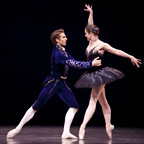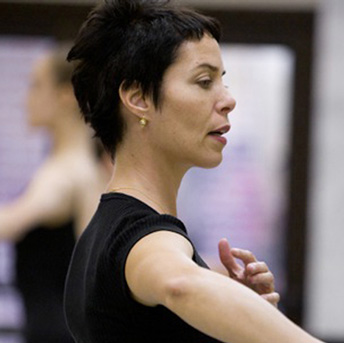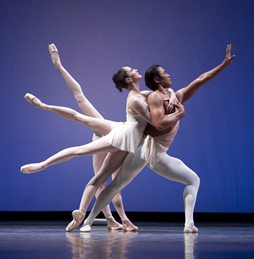
Choreography by Ratmansky
American Ballet Theatre
Choreography by Alexei Ratmansky
Guggenheim Works & Process
September 30, 2012
In 1986, renowned choreographer Alexei Ratmansky graduated from the Bolshoi Ballet Academy, having never heard the names Rudolf Nureyev or Mikhail Baryshnikov, and having never seen the choreography of George Balanchine. To comply with the policies of the Soviet Union, the Bolshoi did not discuss these men and their works. Ratmansky graduated during a tumultuous era, as the Soviet Union was beginning to collapse, and the VCR and video tape were coming into personal use, introducing him to a whole new world of choreography and dancing.
While being interviewed by former Artistic Director of the Royal Winnepeg Ballet, John Meehan, at Guggenheim’s Works and Process last weekend, Ratmansky described the era as being very disorienting to students who had come up with only strict classical training. Their understanding of choreography mostly revolved around the works of Marius Petipa and Yury Grigorovich. As the outside world began to filter in to Russia, and as Ratmansky left Russia, he originally found himself resisting the new influence, in his mind and his body. This was typical of most dancers who were his contemporaries, trained in the Soviet Union.
Ratmansky danced for Meehan and the Royal Winnepeg Ballet in the early 1990s. Meehan remembered him as being a romantic dancer noted for his very soft landings. A short film showed Ratmansky in performance during that era, and it illustrated the extraordinary quality of his landings. Ratmansky told the audience that this quality came as a result of being made to do petit allegro at an adagio tempo (“It was killing!”) and battement tendu at 32 counts going out and 32 counts coming in.
He said that the Bolshoi always wanted their dancers to “color” the movement. After leaving the Bolshoi, when Ratmansky began to learn new choreography, he was encouraged to just do the steps. “Don’t act. Be more simple.”
He began choreographing for himself, on his own body, then had to learn how to choreograph on other dancers, beginning with his wife Tatiana. One of his first big jobs was a commission from the Kirov to choreograph their Nutcracker. He was on a one month deadline. “Every big work is crazy and intense with very little time.”
When the Soviet Union collapsed, people turned their attention away from works of the Soviet era, including The Bright Stream. Fifteen years later, the public began to feel nostalgic for the old works. Ratmansky loved the Shostakovich score and thought that the time could be right to stage a new version of The Bright Stream.
Veronika Part and Stella Abrera danced Zina and the Ballerina, a touching and heartwarming excerpt from Ratmansky’s The Bright Stream, in which two old friends who attended ballet school together are reunited. Every small detail in the movement displays the warmth between the women, especially in the moment when they reach out to lift each other’s chins so that they can see into each other’s eyes.
Even before the premiere of Ratmansky’s The Bright Stream, the Bolshoi Ballet, who did not accept young Ratmansky as a dancer, asked him to take over the entire company. He was 34 at the time. He took up the challenge and found himself in charge of 220 dancers and 20 coaches, some of whom were legends in the ballet world.
At the time that he took over, the Bolshoi was still very conservative, holding dancers in higher esteem than choreographers. So Ratmansky brought in new ballets choreographed by George Balanchine, Twyla Tharp and Christopher Wheeldon among others. In the course of his five year tenure, he introduced thirteen new ballets. There were 250 performances per year on two different stages. He hired new dancers fresh from the school to learn the new repertoire, as the older ones didn’t always “get it”.
Even after five years of working with the Bolshoi, he still felt that the resistance to new works and new choreographers remained very strong in Russia. So he left and came to New York to pursue his choreography. American Ballet Theatre invited him to be their Artist in Residence. He just signed a long term contract with the company, and he enjoys the support he receives and the freedom to create abstract and narrative ballets. He reflected fondly on the company’s history of embracing Russian emigres.
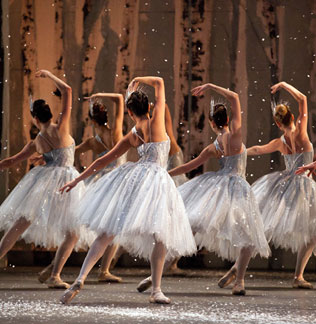
We saw a short excerpt of the scene from the Nutcracker that bridges between the battle scene and the Land of Snow. I’d seen ABT’s new Nutcracker in the middle of a blizzard in 2010, but I’d forgotten how much I’d loved it until I saw this charming section in which Drosselmeyer’s nephew transforms into the Prince. In Ratmansky’s version, two adult dancers enter upstage and mirror some of the movement of the children, who are imagining their future selves. It struck me that in the gestures of the adults, we see traces of the children they once were. As in most Ratmansky ballets, there is always the presence of light hearted humor along with the warmth. I especially loved the excitement of the children as the first snowflakes start to fall.
Ballet Mistress Nancy Raffa and principal dancer David Hallberg joined Mr. Meehan to speak of their experiences in working with Ratmansky. Ms. Raffa said that Ratmansky always comes to the studio well prepared with a clear vision and a little black book in which he has worked through the details of his choreography. Mr. Hallberg said that Ratmansky doesn’t move forward until one section is perfected. They will work on eight counts for “what feels like two weeks”. About Ratmansky’s Nutcracker, Mr. Hallberg talked about the nervousness that he and Gillian Murphy experienced the first time that they danced it on stage. “He completely blew what we thought we knew about Nutcracker out of the window.” Hallberg’s words resonated with me and that’s part of the reason why I was so stunned by some of the backlash that the new Nutcracker received. I loved Ratmansky’s telling of the story from the very beginning, precisely because he brought a new and wonderful perspective to it.
Ratmansky’s new ballet, Shostakovich Symphony No. 9 will premiere Thursday, October 18, 2012 at New York City Center.
Tags: Alexei Ratmansky, American Ballet Theatre, Guggenheim Museum Works and Process, John Meehan, The Bright Stream
October 10, 2012 No Comments
New York City Ballet – Guggenheim Works & Process – Year of the Rabbit
New York City Ballet
Guggenheim Works & Process
Year of the Rabbit
September 23, 2012
Last weekend as part of the Guggenheim’s Works and Process, New York City Ballet Media Director (and former soloist) Ellen Bar moderated a discussion with NYCB dancer Justin Peck about the new ballet he’s choreographed, Year of the Rabbit, which will be receiving its world premiere on October 5, 2012 at the David H. Koch Theater. Also on the panel were composer Sufjan Stevens and arranger and conductor Michael Atkinson. In addition, the audience was treated to a few excerpts of the ballet, accompanied by a live string quartet.
Year of the Rabbit began as an original work by Sufjan Stevens, composed for electronic instruments with lots of overdubbing. The music describes the signs of the Chinese Zodiac, the characteristics of the animals represented, and their relationships to one another, some in rivalry and some in friendship.
The evening began with a very short film of an excerpt from the ballet being performed on what looked like a Fire Island beach. I was instantly captivated by the swells of the music, which sounded before the movement began. Dense, atmospheric, dramatic, and quirky, it reminded me of the things that excited me most in the progressive rock music of the early 1970s. Later in the evening, as Michael Atkinson described his process in arranging the music for New York City Ballet’s Orchestra, he mentioned the inspiration of composers like Stravinsky and Bartok. Peck first heard Stevens’ music on WNYC-FM and he felt that it would be great for dance. He’d already been commissioned by Peter Martins to create a new ballet when he first approached Stevens about using the music, and having it orchestrated.
Joaquin de Luz seemed perfectly cast for his solo in Year of the Rabbit. Peck explained that rabbits elude their predators by darting back and forth. This is described in the music in quirky phrases of 5/6. As the solo begins, de Luz is shifting his weight from one foot to the other. Once he takes off, he leaves the ground in a spectacular series of leaps and turns, constantly changing direction and constantly traveling until he pauses at the end of the excerpt to look around, as if checking to see if he’s still being hunted.
Teresa Reichlin and Robert Fairchild danced a quieter excerpt. The music slides from rousing to lush, and Ms. Reichlin’s developpes are lyrical, dreamy and expansive. Peck worked to create unconventional movement, guided by the abstract and sometimes weird sounds in the music. The movement is so lovely, with surprising and beautifully unusual details.
It was wonderful to watch Justin Peck coaching Tiler Peck through a short solo that will be danced with a larger cast at the Koch Theatre. He explained that in this section of the choreography, the upper body and lower body moved as two separate parts, with one part initiating the movement for the other. They worked together on little actions which could “stretch out or condense” a passage of music.
Peck mentioned that the full ballet will have a large cast of dancers, and given the density and complexity of the music, I could imagine that a large cast would work superbly and create great excitement on stage.
In the hours when dancers weren’t available to rehearse with him, Peck worked out his ideas on paper. We were shown drawings he’d created, which resembled layered floor plans of the stage, color coded to depict the dancers and the directions in which they’d travel and the spots where they’d arrive. One of the musicians commented, “It looks like a game of Twister.”
I found it interesting that both Stevens and Atkinson had little interest in the ballet before they began working with Peck. Stevens had once been “dragged” to see Apollo, and he had found it to be restrictive, formal and conservative. But as Peck drew him into the ballet world, and took him to see the legendary Balanchine ballets, Stevens came around to understanding them, and then falling in love with them. He said it was “sublime” to see his music expressed with the human body. As a student at Julliard, Atkinson had lived in the same dormitory as SAB students, but admitted that he too needed to be “educated”, and that as his collaboration with Peck continued, so did his appreciation of the classic Balanchine works. It was fascinating to hear the musicians speak about their impressions of the dancers’ process. They remarked about how quickly and how hard the dancers worked and how their communication happened in a language that was different from that of the musicians. Peck explained that part of his job included “translating” between the language of music and the language of dance, saying that dancers hear music differently than musicians. He worked with Atkinson to adjust the dynamics of the music so that the dancers would be able to crucial details when they are on stage in the theater.
I was very excited by what I saw last weekend and I’m so looking forward to seeing the entire ballet.
Year of the Rabbit will have its world premiere on October 5, 2012. Tickets are on sale now.
Tags: Ellen Bar, Guggenheim Museum Works and Process, Justin Peck, Michael Atkinson, New York City Ballet, Sufjan Stevens, Year of the Rabbit
September 25, 2012 No Comments
American Ballet Theatre: A Cast of Characters
American Ballet Theatre : A Cast of Characters
Works and Process at the Guggenheim
April 30, 2012
Every time that I write about a Works and Process event, I always feel the urge to open the article by gushing about how grateful I am for this series. For those of us who love American Ballet Theatre and who love the ballet in general, it is wonderful to be shown the details – small and otherwise – that the artists take into consideration as they create the works that touch our hearts.
This presentation, hosted by Vassar Dance Professor John Meehan, covered Character Dancing, Dancing Character Roles, and Characterization, three distinctly different topics.
The evening opened with the Hungarian Czardas from Swan Lake performed by ABT’s Studio Company with Kristi Boone and Roman Zhurbin in the featured roles. Meehan spoke with Boone and Zhurbin about the makings of a good character dancer. They emphasized the dancer’s need to be versatile and they stressed the importance of epaulment and port des bras. Zhurbin said that in character dancing, he tends to move with a different physicality. His weight is pushed down to the ground, as opposed to being pulled up in the familiar ballet postures. Boone talked about the difficulties in dancing character roles when she’s also dancing on pointe in another part of the same ballet. Quick costume changes which include a change from boots to pointe shoes are complicated, as pointe shoes can take a long time to put on, and the feet tend to swell with the change of shoes.
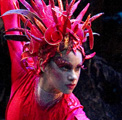
To talk about characterization, Meehan introduced Misty Copeland, who will be dancing the role of Firebird when ABT presents Alexei Ratmansky’s Firebird beginning on June 12th. It was such a great treat to see Copeland, clad in a red unitard and a luxurious red tail, performing a short dramatic excerpt, full of quick and birdlike footwork, and sailing attitude turns. The preview made me very excited about seeing the upcoming production.
She said that Ratmansky expressed the entire story in movement and that he didn’t instruct her about how to look. Isabella Boylston and Natalia Osipova will also be dancing the role, and Copeland said that they give three very different interpretations. She described Ratmansky as being calm and easy going, even when revising choreography up to the last minute. She also spoke a bit about the costume, especially about the tail, and the moment of truth when she has to find a feather to pluck and give to Ivan. This happens on the heels of a grueling pas de deux, and she has exactly half a count of music to find the feather and pluck it.
I was so surprised to learn that Copeland began her ballet training at the age of thirteen, as most ballet dancers start so much earlier. With only four years of training, she was invited to join ABT’s Studio Company. It was interesting to hear her say that she only recently started feeling more comfortable in her technique, because her dancing is just so sensational.
The next speaker was Reid Anderson, Artistic Director of Stuttgart Ballet. He was so endearing and so refreshingly honest as he spoke about his training and his early career. He said that within the Royal Ballet School, he felt like the lumberjack from Canada and anything but a purist. When he was invited to join the Stuttgart Ballet, he was candid with choreographer John Cranko about his insecurities. He described his body as being difficult — a pack of cigarettes on 2 toothpicks – and Cranko said, “That’s what I like about you.” Anderson, who described the 1969 company as a group of misfits, was told by Cranko that many can do the steps, but very few can dance.
Anderson told a story about Cranko, who when working with Marcia Haydée said that he did not want her to be coached – he wanted her to go on instinct. He preferred natural acting over stylized ballet gestures. He wanted the audience to be able to understand the entire ballet even if they hadn’t had time to read the program. Under Cranko’s direction, Anderson and the dancers learned to be theatrical.
It was fascinating to learn about the detail that goes into characterizations. We watched Cory Stearns in the role of Onegin, dancing the Book Pas de Deux with Hee Seo, as Anderson explained the importance of Onegin’s focus. When his gaze is focused upward, it’s to show that he’s thinking about what was, or what could be. When his gaze is cast downward, he’s thinking about what’s happening in the moment. He shows the audience that he’s unimpressed with Tatiana’s book, but his back is to her so that she can’t see how he feels. He lifts her, but looks away as he lowers her, to show us that he’s putting her out of his mind. I absolutely loved Anderson’s description of Onegin’s “searching arabesques” – even with his privilege and good looks, he’s just not happy and he’s searching for something that he can’t find. This vocabulary of movement shows us the way that Onegin toys with Tatiana’s affections, but keeps drifting away emotionally and going back inside his own head.
Roman Zhurbin demonstrated a medley of excerpts from a series of five character roles, one right after the other. It was amazing to see him switch from one character to the next every few minutes. He talked about the heavy movement and the weight that he uses when playing Lord Capulet, as he demonstrated how he marches toward the audience. Then he danced Inspector Gavrilych from The Bright Stream, and talked about how he pictured him as being bowlegged “as if he’d just gotten off a horse”. I am someone who swoons every time that I see any part of ABT’s Swan Lake, so I especially loved his excerpt from Act 4, when Odette struggles to protect Siegfried, and Zhurbin as Von Rothbart reminds Siegfried that he’s already sworn eternal love to Odile. Even though Zhurbin stood on a bare stage with no costume and no orchestra, that little excerpt really stirred my fondest memories of the dance. When I see Swan Lake again this year, I’ll have to pay closer attention to Von Rothbart.
The evening closed with the Danse Russe from Act III of Swan Lake, and talk about Kevin McKenzie’s decision to give Von Rothbart some more dimension by having him flirt with the princesses at the party. Sascha Radetsky danced Von Rothbart and I was taken by the intimacy of this performance, and the way that it held its own without the stunning sets and lighting or the big orchestra.
Tickets for American Ballet Theatre’s Met Season are on sale now. I can’t wait for it to begin.
Tags: Alexei Ratmansky's Firebird, American Ballet Theatre, Guggenheim Museum Works and Process, John Cranko, Misty Copeland, Onegin, Reid Anderson, Roman Zhurbin
May 4, 2012 No Comments
Royal Danish Ballet – Works & Process at the Guggenheim
Nikolaj Hübbe and the Royal Danish Ballet
Live Web Stream
Sunday, March 20, 2011
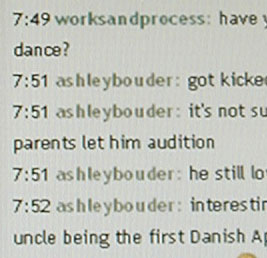
This is my second experience with watching a simulcast provided by the Guggenheim’s Works & Process Series. Not only is the series a wonderful concept, in which an Artistic Director can offer insight into dances moments before they are presented on stage. But having the opportunity to watch the presentation on a video stream while reading the scrolling chat in an adjacent window on my computer screen, and being in the “virtual” company of knowledgeable fans and one of my favorite ballerinas — Ashley Bouder — throughout the evening is the icing on the cake.
In this edition of Works & Process, John Meehan, Professor of Dance at Vassar College, interviewed Nikolaj Hübbe, Artistic Director of the Royal Danish Ballet and former principal dancer of New York City Ballet. RDB presented a program which combined the new — an excerpt from a work by Jorma Elo – with the old, a ballet called Napoli, choreographed in 1842 by August Bournonville. From the 1830s through the 1870′s, Bournonville choreographed over 50 ballets for RDB, creating a unique style that became the company’s signature.
The evening opened with Hübbe speaking about the way that Bournonville structured class. After his death, his students codified his teachings with steps or combinations titled for the days of the week. The first dance of the evening, an excerpt from Bournonville Variations, paid homage to his system. Five men dressed in gray, some wearing jackets which made reference to characters from classic ballets, performed an assortment of these combinations. Most of what we saw was petite and middle allegro work, sometimes performed with unusual port de bras, including one sequence where the men danced with their arms folded across their chests. The sequences moved along lines or on the diagonal, as they would in class. As a ballet student, all I could think of was how challenging all that footwork must have been. It seemed as if it never let up. The men performed it so beautifully, and their footwork was so quick and clean.
During the break, Meehan interviewed Hübbe about his training. Hübbe had it in his mind at an early age that he wanted to be a ballet dancer. His parents originally discouraged him, placing a higher value on his academic education. But by the age of 9 he’d managed to convince them to let him audition at the Royal Ballet School. He said that during his student years in Denmark, male ballet dancers were considered to be “men of craft”, on par with intellectuals and artists, and that there was no stigma involved in being a dancer.
Before I heard this interview, I never realized that Balanchine had served as Artistic Director of the RDB right after he left the Ballet Russes. He set Apollo on the RDB, and Peter Martins’ uncle became the first Danish Apollo.
The first piece in the next dance section was an excerpt from Jorma Elo’s Lost on Slow. Then came Bournonville’s Jockey Dance, a tip of the hat to the English love of horse racing. Hübbe described the theme of this ballet as being, “Anything you can do, I can do better.” I was taken by the fleet footedness of the dancers, veteran Thomas Lund and newcomer Alban Lendorf. Ashley Bouder said that one would rarely see footwork like this anywhere else. Even the hips become involved, as the dancers turn in and out at breakneck speed, each one trying to outdo the other. This piece was followed by an excerpt from Bournonville’s A Folktale. The costumes used in all the dances throughout the evening were absolutely beautiful, but the crimson red dresses worn by the ballerinas in A Folktale were just extraordinary.
The interview continued with talk of the Royal Danish Ballet itself. The company is 250 years old, and was described as being “notoriously difficult to direct” because of some of the archaic rules involved. In America, private enterprise runs the dance world. But with the Danes, it is all subsidized by the state, and with this come rules that can not be violated. One of the rules requires that dancers have to retire at the age of 40, so freelancers have be hired to play roles like the parents in La Sylphide. The Artistic Director has to maintain the balance in keeping tradition alive while keeping current with the times.
Hübbe also said that, as a young dancer, he wanted to come to America and dance with New York City Ballet because he wanted the opportunity to “step out of the story” and to prove that he could “dance without a liberetto”. So it was amusing that when he came to NYCB, the first ballet in which he was cast was Donizetti Variations, which has a libretto.
The next dance was an excerpt from Bournonville’s La Sylphide. I wish that I could credit the ballerina who played this role, because she was so lovely. Her port des bras especially was so expressive. She really embodied the look and the movement of a fairy from the forest. I would love to see RDB’s full length ballet.
The evening closed with a celebratory tarantella from Act III of Napoli, full of exuberant dancing and lovely colorful costumes.
The Royal Danish Ballet is about to embark on an American tour which will bring them to the Koch Theater at Lincoln Center, among other places. They will not be able to perform the full length La Sylphide here in New York City because the theater doesn’t have a deep back stage area and can’t accommodate the sets. Ashley Bouder added that behind the stage of the Koch Theater, all that they have is a cross over. I had to wonder why Lincoln Kirstein and Philip Johnson would have chosen to have the theater designed this way.
For hours before the performance started, Ashley Bouder was tweeting her reports from the rehearsals. She mentioned that the dancers were concerned that the floor was very slippery. Hübbe, who had been nothing but charming and charismatic and completely natural throughout the entire evening, ended the performance by thanking the dancers and expressing his relief that no one had fallen during the show!
The program is archived here.
Tags: Ashley Bouder, August Bournonville, Guggenheim Museum Works and Process, John Meehan, Nikolaj Hübbe, Royal Danish Ballet, The Jockey Dance
March 23, 2011 No Comments
Big Thanks To Works and Process and Pacific Northwest Ballet
Guggenheim Works and Process – Live Web Stream
Pacific Northwest Ballet’s presents Giselle Revisited
Sunday, January 9, 2011
On Sunday night, I had the opportunity to view a live web stream of the Guggenheim Museum’s Works and Process from the comfort of my home. The Pacific Northwest Ballet (PNB) presented Giselle Revisited.
Before last night I had very little knowledge of the company. I’d seen their Nutcracker on television and that was about it. So it was wonderful to have a chance to see them in this setting. Beyond that, I have never before had the opportunity to see a ballet deconstructed to the extent that the presenters (Doug Fullington, Marian Smith and choreographer Peter Boal) did for Giselle. I was impressed by the extent of their research and the fascinating details that they unearthed and shared with the audience.
They opened by speaking of the history of Giselle and their work in reconstructing the ballet through the use of primary sources. The audience had the opportunity to view images of the original music scores, which had been written in the dance studio, along with pages of Stepanov notation, which had been done for the entire ballet. I’ve spent a fair amount of time in ballet classes and theaters, and I’ve worked behind the scenes with a small ballet company, but before I saw this presentation, I never truly understood the intricacies that were involved in this classic ballet.
The presenters also pointed out voices in the music and what they were meant to say, to accompany the mime and action in the ballet. Mention was made too of this ballet’s influence on Balanchine. He never created a Giselle of his own, but one of the presenters pointed out distinct references to Giselle in Serenade and Baiser de la Fee. I’ve seen both ballets several times, but before now I never understood the connection.
The dancers, Carrie Imler, Carla Korbes, Seth Orza and James Moore, were just amazing. Technically, they handled complex and speedy footwork with apparent ease. Artistically, they really became the characters whom they were playing, even during these short little excerpts from the ballet. I was especially taken by the port des bras on the women. Their movement filled the music so beautifully.
This presentation left me with a new appreciation for Giselle. I can’t wait to see it again, and now I’m so curious about all the hundreds of little details and references that must go in to the creation of every ballet. I’ll also be sure to see PNB when they come back to New York City.
I am so grateful to PNB for putting together this presentation and to the Guggenheim Museum’s Works and Progress for streaming it over the web. I feel that it’s presentations like these that will keep ballet alive and keep the audience engaged. I also really enjoyed the chat that went on alongside the webstream, which was populated with some of my favorite bloggers and other knowledgeable ballet fans.
The best part of all was that when it was over, I didn’t have to trudge to the subway and look forward to an hour plus trip back home to Brooklyn!
The webcast is archived here.
All photos by Jesson Mata.
Tags: Giselle, Guggenheim Museum Works and Process, Pacific Northwest Ballet
January 10, 2011 No Comments